
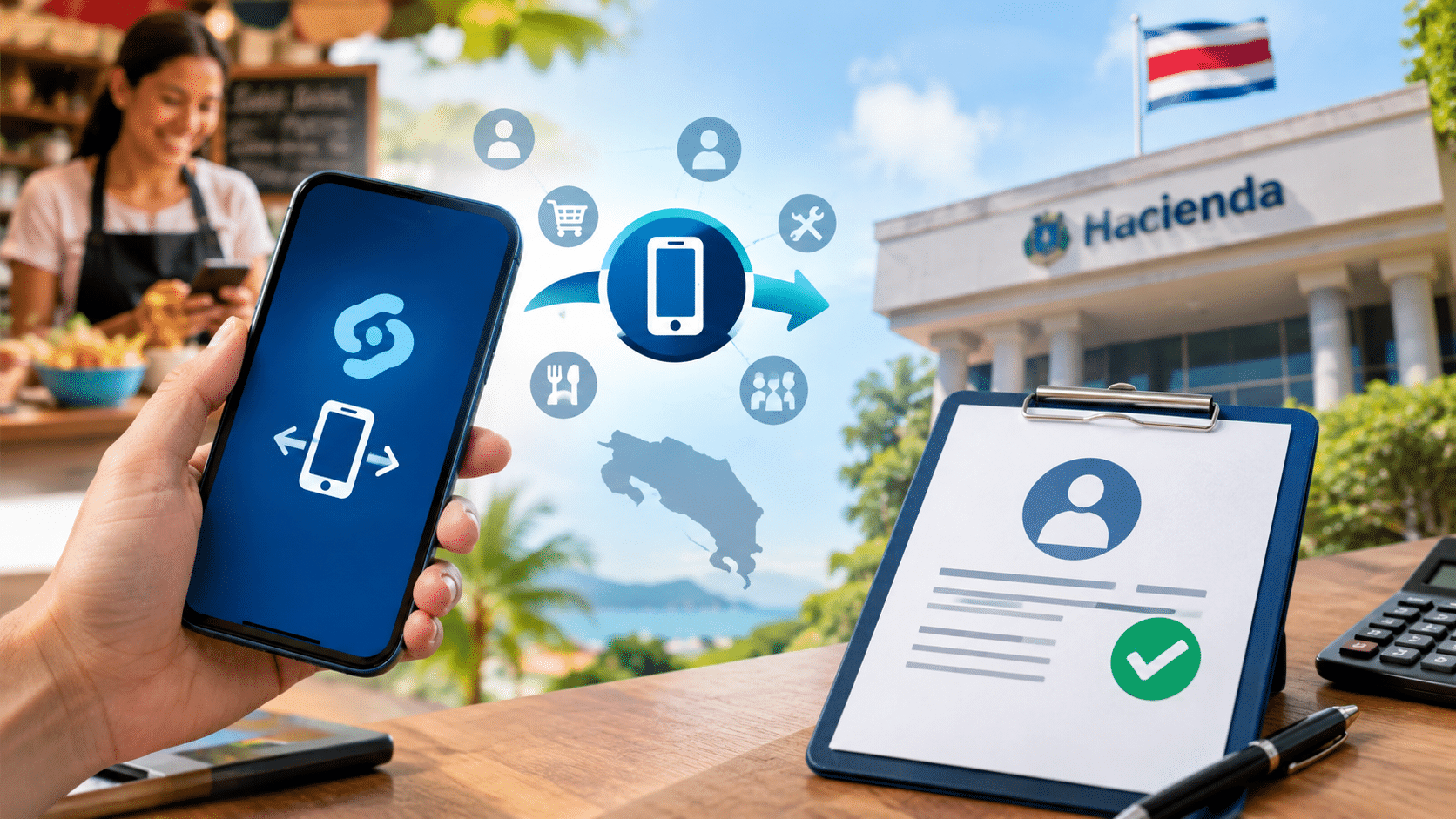
Sinpe Móvil and Hacienda: What is changing and what is not (yet)
What happened
Friday, October 16, 2026, was published in La Gaceta (Official Monitor of Costa Rica)Executive Decree 45953-H. He adds a new point to Article 22 of the Regulatory del Procedimiento Tributario and says, in short, the following: Who uses sinpe móvil In his economic activity, he must register Ministerio de Hacienda (Ministry of Finance) the number or phone numbers related to the bank account through which they collect.
Sinpe Móvil is the instant payment service between a telephone and the bank account, managed by Banco Central by Costa Rica, which almost everyone uses: from paying for a lunch to paying a craftsman. Registration is done in Pairing season (Regisco Único Tributario, Single Registry of Taxpayers), either upon entry in the register or through a change of data.
Two important clarifications from the beginning. The decree does not create a new tax on Sinpe Móvil and does not limit the use of the service. creates a registration obligation, for a particular group.
What doesn't happen now
The decree has been in force since publication, but the obligation does not apply from today to tomorrow, and those affected They have nothing to do now. The steps are as follows:
- Hacienda has no more than 3 months since the entry into force of the decree to adapt the registration and modification form of the data from the RUT and its systems.
- In the same term, the hacienda must issue A general resolution which explains exactly how the recording is made.
- Representatives of commercial companies and professionals (authorized natural person) Already registered They then have 12 calendar months, counted since the entry into force of the resolution (not the decree), to register their phone numbers.
In other words, until the resolution appears there is neither a form nor a procedure. On 21 October 2026, the resolution is not published.
The obligation refers only to the phone numbers used as a means of payment in the economic activity. Not all transfers through Sinpe Móvil are economic activity, and the decree expressly recognizes this: a payment between friends or a family refund is not the same as the collection of a service.
Why Hacienda asks for it
The preamble of the decree gives a few figures: At the end of May 2026 there were 4,801,297 active subscriptions at Sinpe Móvil, and in 2025 they transferred through service approximately 12.5 billion colones (exactly, ¢12,527,728,879,067). Hacienda admits that not all of these operations are related to lucrative activities, but says that some economic ones are not fully declared or escape tax through informality.
The official motivation is traceability: The phone number fills in the information about the payment method that already appears on the electronic comprobants. And this is not really new. Since September 1, 2025, version 4.4 of electronic invoicing has a special code for Sinpe Móvil, as a payment method. Banco Central then explained that there was no new tax and that the change was just a technical reporting requirement. Now the specific phone number is added, which links the taxpayer’s payment.
The information remains protected from fiscal confidentiality (Article 117 of the Fiscal Code) and the legislation on the protection of personal data.
Also in this context, the Deputy Minister of Hacienda said publicly, in July 2026, that attention is directed towards informal affairs and those who receive a large number of payments per month (he spoke of over 150), and the Sinpe control must be treated like any other means of payment, same as cash or card. the figure of 150 does not appear in the decree, so we don’t know if it will reach the resolution.
The real problem: same number for payments and receipts
Here the decree meets a very widespread custom: Almost everyone uses a single number for everything. With him he pays, with him he collects, with him he sends money to the family and with him he receives the money from the customers.
It must be clearly stated that in trade things are generally in order. Supermarkets and stores issue electronic comprobante (invoice or tiquete electrónico), and payment by Sinpe already appears on the document. For those who invoice electronically, the only news is the registration of the phone number.
Between companies, documents are issued, for purely practical reasons: Without an invoice, the company customer cannot deduct the VAT from the one he has to pay and ends up paying twice. At the end of the year, at the income statement, the unpaid expense gives the same problem.
The decree does not change anything for VAT: Sinpe Móvil remains only a payment instrument that Hacienda recognizes, and the rules for invoicing and deducting VAT according to the law.
The area without this correction mechanism is another: Payments between people and small, informal services, where the discussion comes down to “What’s the number of Sinpe?” And the money is transferred, without an invoice. The explanation field in Sinpe (where many write “Otros”) is free text and does not replace the invoice in any way.
Here is a practical problem: If you record the number you use for family and friends, personal transfers and income from the activity mix with the same number.
who is affected
Who already has SINPE and collects in the economic activity: The most exposed are the small merchants with nothing declared, with payments on the personal number.
Foreigners waiting for Dimex: is the resident aliens’ identity document. In operations through Sinpe, Banco Central requires the identification of foreigners through Dimex (LEI 8204, Article 39 of the Regulation), and in practice banks usually require Dimex for Sinpe Móvil to be activated in your name. Until you have it, you don’t have a pen in your name, so you have nothing to record. It’s good to know from the beginning, when you open your account, that the number for business receipts should be separate from the personal one.
Who has a company: If the company has an open bank account, the number may be linked to the company’s account, which solves the separation by itself. To open the account of a new company, the bank requires a document named Flujo de Caja (cash flow projection), drawn up with the Accountant (CPA), with the estimated annual income, the activity carried out and other details. It is a requirement provided by the regulations in force for the opening of accounts by companies, not a custom of a specific bank.
What can be done ahead of time without panic
You don’t have to do anything until the resolution is issued. If you still want to prepare, some tips are useful anyway:
- Separate bank accounts for the individual and business. The rule is that a bank account can have only one phone number affiliated for SINPE: two numbers cannot be affiliated on the same account. It’s the same number you do sinpe with and identify with at the bank. So the separation of accounts also solves the separation of numbers by itself: one account and one number for the business, another for personal life. The number associated with the account is usually changed or assigned from the bank’s platform (the procedure differs from one bank to another). It’s a good practice regardless of the decree, because you see clearly what everyone is doing, and there is no tangle with the receipts and payments through SINPE.
- bill for each service: and in the document the selection of payment with SINPE and in the client’s explanation for the transfer, the number of the invoice or what the payment represents.
The goal is order, not masking. Moving the proceeds to an undeclared number solves nothing.
What if you don't register
The decree says that after the expiration of the deadlines Above, the lack of registration attracts the penalty from Article 83 of the Code of Tax Rules and Procedures. This article concerns failure to fulfill the obligation to provide information. The law sets a range: a fine of 2% of the gross income of the previous fiscal period, with Minimum 3 and maximum 100 basic salaries. As the basic salary of 2026 (¢462,200), that means between ¢1,386,600 and ¢46,220,000.
The interval is clear. However, the concrete amount in a specific case is not quoted directly from the law. It is established by the tributary administration, in each case, through a sanctioning resolution that can be contested within the stipulated term. The law also provides for reductions if the situation is corrected on its own initiative (for example, 75% if the update is made no later than three days after the deadline), and the hacienda can waive the sanction in case of demonstrated force majeure.
However, the decree does not explain how Article 83 will apply precisely when re-registering phone numbers, so the figures above are a legal framework, not a forecast.
It is not clear for specialists either: In reality, the Hacienda inspectors decide the application, case by case.
My opinion is that not registering a phone number (SINPE) most likely falls under the first category of Article 83, “Incomplimiento en el Suministro de Información” (non-fulfillment of the obligation to provide information), precisely because the decree refers to this article. However, an opinion remains, not a confirmed rule.
What we don't know yet
- The exact form of the resolution to be issued by the hacienda and the registration procedure.
- How simple the procedure will be for those who already invoice electronically.
- What term do those who register after the resolution have: the 12 months are provided only for those already registered.
- If there will be a volume threshold, as the Deputy Minister suggested.
- If the hacienda will also have access to the explanation field in the transfer, not just the phone number.
- how personal transfers will be treated on a registered number.
In short
Decree 45953-H requires that the Sinpe Móvil numbers used in economic activity be registered in the RUT. Hacienda has 3 months for forms and resolution, and those already registered are then 12 months old.
For those who bill correctly, the change is small. For those who use only one number for all transactions, the easiest way to put orders is to separate bank accounts: one for the business, the other personally, each with their own number.
The information in this article comes from the text published in La Gaceta and from Hacienda’s official documents; What doesn’t appear there is marked as “not yet known”.
For your concrete situation, talk to your accountant (CPA). The article will be updated when the General Resolution appears.

Source
 Behind OpenZone are two people: a Costa Rican native with deep roots in the local history, and an expat who has been settled here for over two decades. Together, we combine native knowledge of the system with firsthand experience of the very process you’re going through right now.