
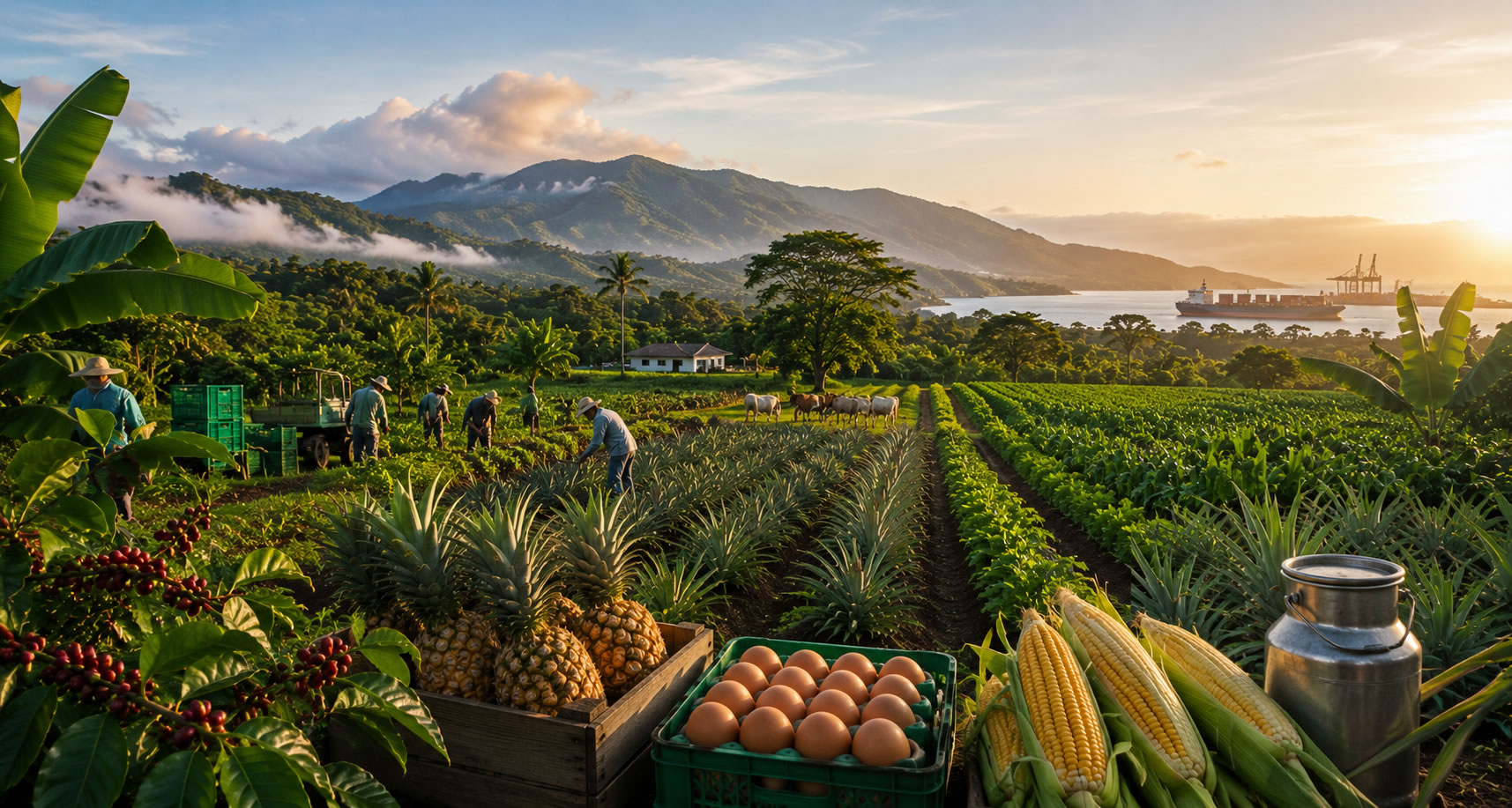
How big is agriculture in Costa Rica's economy?
The Agricultural Sector in Costa Rica – Contrary to the perception of an “agricultural country”, the agricultural sector only represents 3.6% of national GDP in 2024, down from 3.8% in 2023. It is not a crisis of the sector, but an effect of the faster growth of other areas — real estate, professional services, technology — which are growing faster than agriculture, not because agriculture would decline in absolute terms.
In fact, agricultural activity has increased by 16,3% in the last decade (2015-2024), although with periods of contraction clearly linked to external factors: the drought of 2015 and 2019 (El Niño phenomenon), the 2020 pandemic (-1.4%, caused by the closure of international markets) and the global container crisis + the war in Ukraine in 2022 (-2.3%).
Agricultural Added Value reached ₡1,749,719 million in 2024, of which 69.7% comes from agricultural production (crops), 20.9% from livestock production (animals), and the rest from forestry, fishing and support activities.
Foreign trade: the sector that brings money to the country
Here’s one of the most relevant figures for anyone thinking about farming as a business: while Costa Rica has a deficit national trade of -9,537 million USD in 2024, the agricultural sector has a surplus comercial constant, over 2,300 million USD annually in the last 5 years. In fact, agriculture is one of the few sectors that brings in more money from abroad than it spends on imports.
Agricultural exports increased by over 38% in 5 years (from 4,912 million USD in 2020 to 6,797 million USD in 2024). The main destination is the USA ($2,013 million), followed by Guatemala, the Netherlands, Belgium and Nicaragua. Agricultural products (bananas, pineapples, coffee) represent 53% of agricultural exports, and the processed food industry another 38%.
What is really being cultivated?
what's going well vs. what's falling apart
Here’s the most useful part for someone who is thinking concretely about what culture would make sense:
Clearly increasing:
- Ananasul (pineapple) — from 2.65 million tons (2020) to 3.12 million tons (2024), the strongest growth trend
- maize — +44.5% since 2020
- Egg production — +12.7% in 2024 alone, reaching a record level
- Cow’s milk — sustained growth 2020-2023, slight decrease in 2024
- Certified organic production — constant growth trend over the last 25 years, although fluctuating year by year
Declining or unstable:
- Rice — the most dramatic collapse: -57% in 4 years (from 146,571 tons in 2020 to 64,214 tons in 2024), due to reduced import tariffs and low yield per hectare
- Coffee — general downward trend, -5.9% on average, although with alternating production cycles
- Onion — -29% only between 2023 and 2024
- potato — -8% between 2023 and 2024, with historical cyclical behavior
- Export bananas — slight negative long-term trend (-1% on average), although with fluctuations
- Raising pigs and beef — relatively stable production, but without a clear growth trend
The practical conclusion: pineapple, eggs and corn are clearly expanding; rice and coffee are in structural decline, not just seasonal fluctuation.
Who works in agriculture — and how they live?
Here the report paints a less idyllic picture. In 2024, 197,887 people they worked in agriculture, animal husbandry, and fishing — only 9% of the employed population nationally, fifth in importance, below trade, communications, industry, and education/health.
Some key figures:
- 49% of agricultural employees work informally — without social protection, contract or formal accounting
- The minimum agricultural wage is 33.6% lower than the national minimum wage for an unskilled worker (₡239,073/month vs ₡358,000/month in 2024)
- The Huetar Caribe and Huetar Norte regions concentrate 57% of the agricultural workforce of the country
- Only 37% of the employed rural population is young (15-35 years old) — a clear signal of an aging agricultural workforce, with young people migrating to cities for studies or other opportunities
On the positive side: Labor productivity has increased by 37,4% from 2019 to 2024, even though the number of workers fell by 24% over the same period — a sign of increased mechanization and efficiency, but also of possible loss of rural jobs.
A relevant detail for someone coming from Europe: income inequality (Gini coefficient) has historically been higher in rural areas than in urban ones, although the gap has narrowed significantly since 2019, reaching almost equal levels in 2024 (0.482 rural vs. 0.483 urban).
Sustainability: where the state invests
Costa Rica is actively pushing the sector towards organic production and sustainable practices: 10,360 hectares certified organic in 2024 (coffee, bananas, pineapples being the main crops), with 98% of organic exports going to Europe (75% to the Netherlands alone). The state has already installed 20 of 25 planned “biofactories” (production of fertilizers based on microorganisms) and grants financial recognition (RBAO) to 714 small and medium-sized organic producers.
What does all this mean, practically?
If you think about farming in Costa Rica not as a hobby, but as a real source of income, the numbers say a few clear things:
- The sector brings real money to the country (constant trade surplus) — so it is not a dying economy, but a strategically relevant one, even if small relative to the rest of the GDP.
- Certain cultures have a tailwind (pineapple, eggs, corn, milk), others are in structural decline (rice, coffee) — the choice of crop matters enormously.
- Income from agricultural work is below the national average, with high informality — if you plan to hire local staff, keep this in mind both economically and ethically.
- Productivity increases through mechanization, not through more workers — a signal that investment in technology/equipment matters more than cheap labor.
- The state actively supports the transition to organic — a niche with solid demand from Europe, if you have the patience for certification (~3 year process).
Agriculture in Costa Rica is neither a hyped-up paradise nor a dying sector — it’s a real industry, with real numbers, winners and losers clearly identifiable in the data. Those who enter it informed, not romanticized, have a real chance of success.
One last observation
I wrote this article based on official figures, but I also have a personal experience that showed me exactly the side that statistics can’t capture. Before the pandemic, I had a small niche business — exotic plants and fruit trees, plus rare birds, from quail to emus.
It wasn’t a subsistence farm, it was a business, with steady customers and sales. When the pandemic hit, I had to give away the animals so they wouldn’t starve, and I lost hundreds of them from the solarium, simply because the cash flow suddenly stopped — not because I “didn’t know what I was doing.”
The numbers in this report tell the story at the country level — growth, decline, productivity. But behind each statistic is a real producer or entrepreneur, exposed to the same risks I felt: weather, market, health, or just a bad year..
If you’re seriously considering farming here — either as a business or as a serious hobby — get informed with the data, but also prepare yourself for the part that no statistics show.

 Behind OpenZone are two people: a Costa Rican native with deep roots in the local history, and an expat who has been settled here for over two decades. Together, we combine native knowledge of the system with firsthand experience of the very process you’re going through right now.