

Growth Engine, External Vulnerabilities and State Resilience Mechanisms
Costa Rica’s Macroeconomic Paradox in 2026
Costa Rica’s Macroeconomic Paradox in 2026 – According to official data from Central Bank of Costa Rica (BCCR), the country’s economy is projected to grow by 3.4% for 2026. At first glance, the numbers reflect a solid emerging economy, a regional technology hub, and an atypically strong currency (the Colón – CRC).
However, a deeper analysis reveals a complex macroeconomic structure and a strong dependence on external factors. For an economic analysis site, the big question is not only how high the risks of vulnerability are, but also how solid the legal and governmental “anchors” are that prevent the collapse of this model.
GDP X-ray: A Dual Economy
To understand the dynamics, one must assess the internal structure of the economy, dominated by services and a high-tech manufacturing sector.
| Branch of Activity / Industry | Share in GDP | Risk | Connectivity |
|---|---|---|---|
| Financial and Professional Services | 21.5% | environment | Dependent on outsourcing contracts (BPO/Tech) in North America. |
| Trade, Hospitality and Transport | 18.2% | Sistema | The sector most exposed to fluctuations in international tourist flow |
| Manufacturing Industry (Total) | 14.8% | Duality | In the Free Economic Zones, the advance is concentrated (+9.4%), the internal regime is stable (+1.8%). |
| Public Services, Education and Health | 12.1% | Rigid sector, governed by fiscal consolidation rules. | |
| Real Estate and Rental Services | 9.5% | Driven by long-term foreign investment in coastal areas. | |
| Agriculture, Forestry and Fisheries | 4.7% | In structural stagnation (-0.5%), pressured by exchange rate appreciation. | |
| Construction and Energy | 7.4% | Dependent on the dynamics of private investments in tourism and industrial infrastructure. | |
| Net taxes on products | 11.8% | Directly proportional to the volume of imports and domestic consumption. |
The Illusion of the Trade Deficit and the Legal Anchor of Free Economic Zones
In the first seven months of 2026, exports of goods reached $13,821 million USD (led by medical devices at 46.3%). In contrast, imports rose to $15,386 million USD, leaving a chronic goods trade deficit:
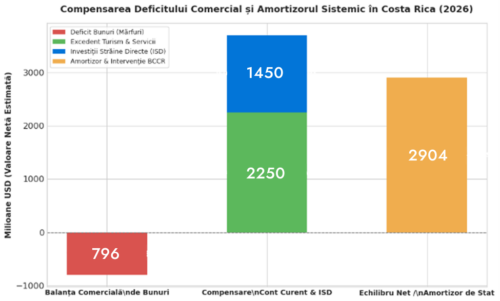
If tourism were to face a global shock (US recession, geopolitical crises), the impact would be asymmetric. However, the hypothesis that the state would passively witness the dissolution of this sector is refuted by the institutional mechanisms established by Costa Rican Tourism Institute (ICT) and by the Executive:
- Funding Shield: The Costa Rican state uses emergency funds and preferential credit lines through the national banking system (BCCR) to support the liquidity of tourism SMEs in times of crisis.
- Diversification and Reorientation Strategies: In the event of a contraction in the North American market (which provides over 40% of the flow), ICT activates contingency plans to attract European and South American tourism with high purchasing power, mitigating the collapse in aggregate demand.
Fiscal Incentives Apparatus: The government has the ability to temporarily relax airport fees and taxes specific to the hotel sector to keep the destination competitive during times of maximum market volatility.
Monetary Dynamics: The Exchange Rate as a Safety Valve
The abundance of dollars brought by tourism and Foreign Direct Investment (FDI) maintained constant upward pressure throughout 2026. appreciation Costa Rican Colon (CRC) on the foreign exchange market (Monex).
This powerful currency acts as a double-edged sword:
- Inflation Protection: It makes imported products cheaper (which represent a large share of consumption), providing stability to the purchasing power of the population.
- Pressure on Traditional Exports: It reduces the competitiveness of the local agricultural sector, whose costs are in colones and whose revenues are in devalued dollars. For this reason, the BCCR actively intervenes in the foreign exchange market by buying dollars to strengthen its international reserves, providing an additional safety net in case of a reversal of capital flows.
The "It's just the way it is" syndrome
The Informal Economy and the Left Behind
All of the aforementioned safety nets — from preferential ICT credits to tax exemptions — have an eliminatory condition: taxing. This is where Costa Rica’s great social vulnerability comes in. A massive part of the grassroots tourism and commercial ecosystem operates in the gray area of informality, guided by the local mentality of “it goes like this”.
Small undeclared accommodation operators (who compete illegally with official platforms), unauthorized local guides, informal transporters or small seasonal traders on the coasts do not pay taxes and are not registered in state registers.
In the event of a macroeconomic shock, these economic actors become completely invisible to the government support apparatus. They cannot access emergency funds or bank refinancing lines. For this huge segment of the population, living from one day to the next on “pocket tourism”, the collapse of the bubble is not a topic of academic debate, but a direct risk of personal financial collapse, leaving a critical mass of citizens completely exposed to any global crisis.
 Behind OpenZone are two people: a Costa Rican native with deep roots in the local history, and an expat who has been settled here for over two decades. Together, we combine native knowledge of the system with firsthand experience of the very process you’re going through right now.