Skip to content
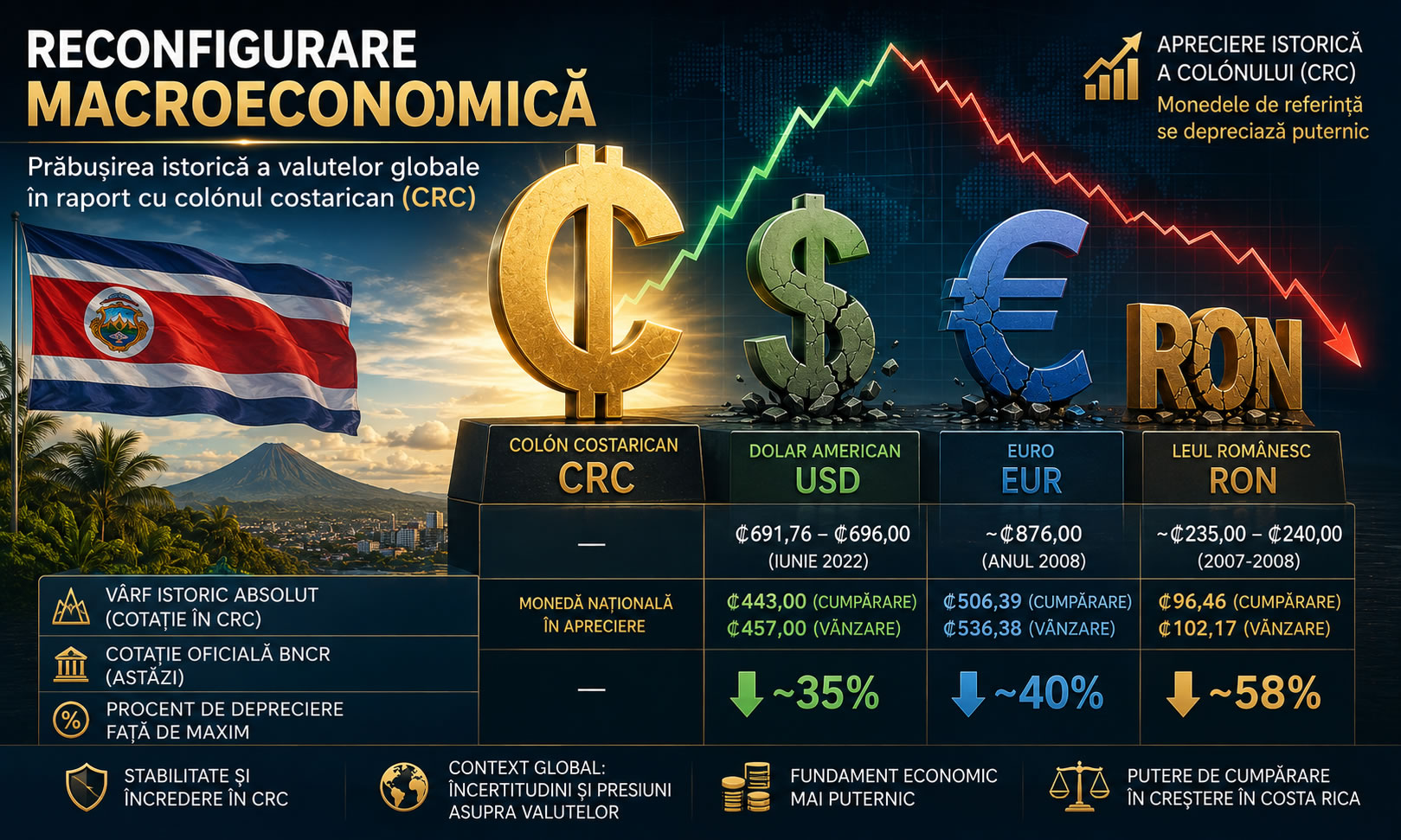
The Historic Decline of Global Currencies Against the Costa Rican Colón (CRC)
Macroeconomic Realignment. The foreign exchange market in Costa Rica is undergoing a profound structural shift, characterized by an aggressive appreciation of the local currency. Global and regional anchors—the US Dollar (USD), the Euro (EUR), and the Romanian Leu (RON)—are experiencing massive corrections and severe depreciations against the Costa Rican colón (CRC) compared to their historic peaks.
This dynamic reflects a clear macroeconomic asymmetry: while European and global economies have battled persistent inflationary pressures and structural slowdowns, Costa Rica’s economy has generated a massive, consistent foreign currency surplus, transforming the colón into one of the strongest currencies in the region.
BNCR Exchange Rate Overview:
From Historic Peaks to Current Reality
Long-term exchange rate trends highlight a sharp depreciation of foreign currencies in the local market, a trajectory continuously reinforced by current interbank trading volumes.
| Currency | Absolute Historic Peak (In CRC) | BNCR Rate (Today) | % Depreciation |
|---|---|---|---|
| US Dollar (USD) | ₡691,76–₡696 (June 2022) | ₡443,00 ₡457,00 | ~35% |
| Euro (EUR) | ~₡876,00 (Year 2008) | ₡506,39 ₡536,38 | ~40% |
| Romanian Leu (RON) | ~₡235,00–₡240,00 (2007-2008) | ₡96,46 ₡100,24* | ~58% |
Note: Because the Romanian Leu is not directly traded over the counter in Costa Rica, the RON/CRC rate is derived via international cross-rate calculations (based on the current parity of 1 EUR = ~5.25 RON and the Euro rate listed by the Banco Nacional de Costa Rica). The direct global mid-market interbank rate hovers between ₡96,46 and ₡100,24 per Leu.
Fundamental Drivers of the Colón's Appreciation
The steep decline of foreign currencies in Costa Rica is not a short-term anomaly, but rather the cumulative result of deep structural economic factors:
1. Structural Dollar Influx (External Liquidity Shock): The local FX market (Monex) is facing a massive oversupply of US currency. This is driven by three main pillars: record foreign direct investment (FDI) inflows into Free Trade Zones (Zonas Francas), robust medical device exports, and a booming tourism sector that consistently outperforms prior benchmarks.
2. BCCR Monetary Policy: The Central Bank of Costa Rica (BCCR) has maintained a restrictive monetary policy, offering highly attractive interest rates on local currency deposits. This economic mechanism incentivized institutional investors and the general public to convert their FX assets into colones to secure positive real yields.
3. The Double Depreciation Effect on the RON: The dramatic drop of the Romanian Leu against the CRC (losing over 50% of its value from its 2007 peak) is amplified by the historic erosion of the RON against the Euro (from 3.6 RON/EUR in 2007 to over 5.24 RON/EUR currently).
The weakening of the Leu within Europe, superimposed on the collapse of the Euro in Costa Rica, created a currency scissor effect that severely diminished the Romanian currency’s purchasing power on Costa Rican soil.
Impact on the Local Economy and Domestic Prices
While a strong national currency signals macroeconomic stability, this phenomenon acts as a double-edged sword within the Costa Rican domestic market:
- Cheaper Imports (Direct Benefit): Imported technology, vehicles, fuel, and raw materials have become significantly cheaper when priced in colones. This factor has been vital in allowing the BCCR to maintain inflation at exceptionally low or even negative levels (deflation).
- Real Estate Market Imbalances: Traditionally, the Costa Rican real estate market operates in US Dollars. For locals earning in colones, properties have theoretically become more accessible. Conversely, expats, foreign investors, and developers bringing capital in USD or EUR find they need substantially larger amounts of foreign currency to cover local construction or acquisition costs, which remain anchored in colones.
- Pressure on Services and Tourism: The tourism sector faces a severe loss of operational competitiveness. International tourists budgeting their trips in USD or EUR are finding their local purchasing power slashed by more than 30%. Restaurants, hotels, and tour operators are forced to either hike their dollar prices to cover colon-denominated payroll costs or compress their profit margins.
TECHNICAL BRIEF
How the MONEX Market Works and Rules the Rate in Costa Rica?
- What is MONEX? It is the organized wholesale foreign exchange trading market in Costa Rica, managed directly by the Central Bank (BCCR). Unlike other nations where commercial banks set rates privately, all major entities in Costa Rica trade on this single unified platform.
- Who Participates? Retail individuals do not trade on MONEX directly. Instead, transactions are restricted to institutional players: the Central Bank (BCCR), commercial banks (BNCR, BCR, BAC, etc.), financial institutions, and authorized multinational corporations requiring high-volume currency conversions.
- How the Reference Rate (Tipo de Cambio) is Set: Costa Rica operates under a managed float exchange rate regime. The rate is determined by supply and demand on the MONEX platform. At the end of each trading day, the BCCR calculates the weighted average of all wholesale transactions, which becomes the official reference rate for the following day.
- Why MONEX Triggered the FX Decline: In recent years, the volume of dollars flowing into the platform via tourism and foreign investment far exceeded the demand from local importers. With the market flooded with dollars (high supply) and fewer buyers (low demand), the price of the dollar dropped automatically on MONEX, dragging down European currencies (EUR, RON) tied to it via global arbitrage.
- The Central Bank’s Buffer Role: The BCCR retains the right to intervene directly on MONEX. If the colón appreciates too aggressively, the Central Bank enters the market to buy dollars in bulk, absorbing the surplus. However, the organic FX influx has been so relentless that BCCR interventions have only managed to slow down the currency’s slide rather than halt it.
Strategic Recommendations and Conclusions
The sustained strength of the Costa Rican colón redefines the financial landscape for foreign entities and European or Romanian citizens with economic interests in the region.
- For Tourists and Expats: The optimal strategy involves avoiding direct currency exchange at airports or commercial bank counters due to unfavorable spreads. Utilizing multi-currency cards that offer direct interbank rates or settling payments directly in colones whenever possible are essential capital-preservation tactics.
- For RON/EUR Asset Holders: Savings denominated in European currencies face severe purchasing power erosion within the Costa Rican market. For individuals planning long-term investments or real estate acquisitions in Costa Rica, it is advisable to time large transactions carefully, waiting for potential market corrections, or diversify portfolios into local financial instruments that offer direct exposure to the colón.
Over the medium term, the Central Bank (BCCR) is expected to stage tactical interventions in the Monex market to prevent further appreciation that could jeopardize export competitiveness.
However, a return to the historic high exchange rates seen in previous years remains highly improbable without a major global macroeconomic shock.