

In short
Tax mailbox from 2027 or 2028
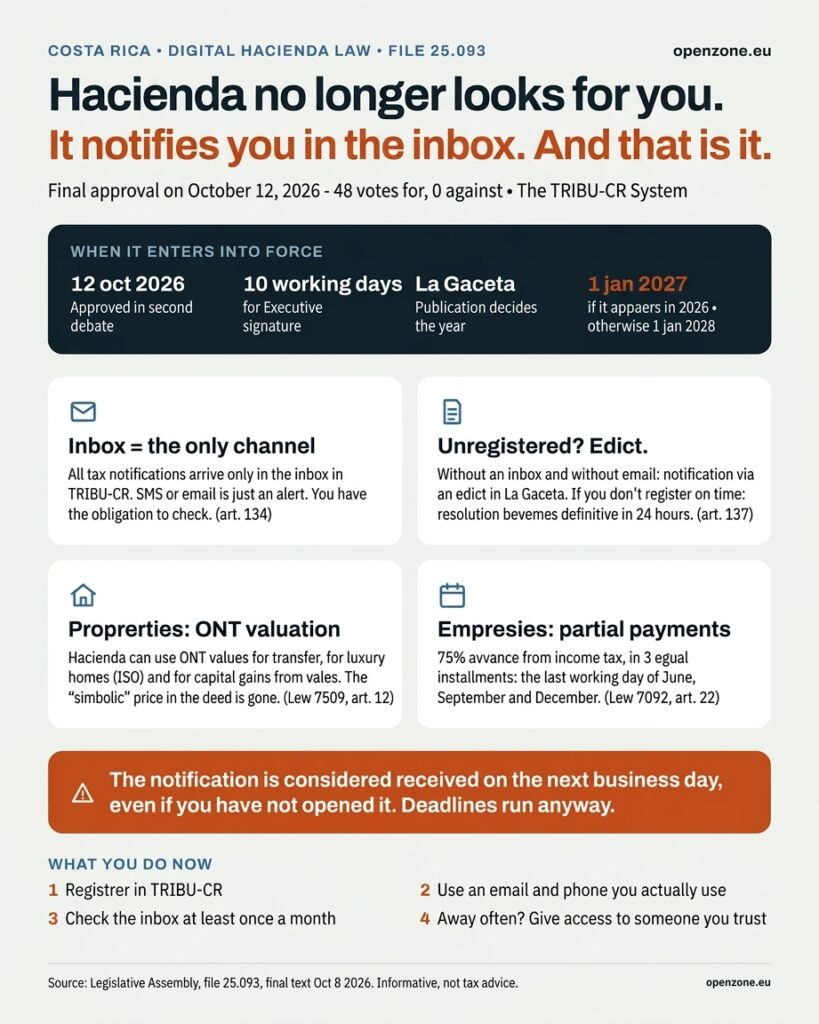
- On October 12, 2026, The Legislative Assembly of Costa Rica definitively approved, in its second debate, the draft exp. 25.093 – “Legal reforms for the implementation of the Digital Treasury project (TRIBU-CR System)”, with 48 votes in favor and none against.
- The law comes into force on January 1 following publication in La Gaceta. If published by December 31, 2026, it applies from January 1, 2027. If publication is delayed to 2027, it will only apply from January 1, 2028.
- Tax office mailbox (electronic mailbox in TRIBU-CR) becomes the only official channel through which the Hacienda communicates everything to you: controls, tax determinations, sanctions, resolutions.
- The notification is considered received the next business day deposit in the mailbox – whether you opened it or not.
- Anyone who is not registered at the Hacienda and does not have a mailbox can be notified through a single edict in La Gaceta, and resolutions can become definitive within 24 hours.
- The Hacienda explicitly receives the right to use ONT assessment tools to transfers, to the tax on luxury homes (Impuesto Solidario) and to gains from real estate.
- The rules are also changing for partial payments (pagos parciales) to income tax.
Note: At the time of writing this article (October 2026), the law has been approved by the Assembly and is awaiting the Executive’s approval and publication in La Gaceta. The text cannot be modified (except for clerical errors). We will update the article as soon as it is published.
Why are we writing about this now, even though it doesn't apply yet?
Because in practice we see the same thing, year after year.
Today, most of our customers already receive notifications from Hacienda via TRIBE-CR (the old ATV platform no longer exists). The system sends a alert email which essentially says: “you have a new notification.” And this email, most of the time, it is not taken into account. It ends up in spam, gets lost among ads, or is opened and closed with the thought “I’ll look at it later.”
We tell them. We also send them on WhatsApp. We offer mailbox monitoring as a service. And yet, many do exactly as they see fit – until a problem arises. We have even had cases where, after the client received information that did not suit them, changed email password in minutes, so that we no longer have access. It’s everyone’s right. But Hacienda won’t ask whether or not you agree with what’s written in the mailbox.
Until now, in many situations there was still a safety net: additional notifications, the possibility of invoking the fact that you were not notified correctly. The new law largely closes this loophole.
1. Buzón hacendario becomes the only notification channel (art. 134 of the Code of Fiscal Norms and Procedures)
The law amends article 134 of Legea 4755 (Tax Code of Rules and Procedures). What the new text provides:
What does Hacienda do?
- It assigns each taxpayer a tax mailbox in the TRIBU-CR system.
- Submit there all notifications, including the act of opening any procedure (control, determination, sanction).
- Send a information alert by SMS or email that you have something new in your mailbox.
What do you have to do?
- You are required to check your mailbox periodically. The SMS or email alert is only informative – if it doesn’t arrive, it ends up in spam or you’ve changed your phone number, the notification is still valid.
- The notification is considered received the next business day the one in which it was deposited in the mailbox.
- For the phases of determination, sanctioning and appeal from a procedure, you can designate one email for that procedure.
What does concrete mean?
From the date of entry into force, The deadlines begin to run from the day following the submission of the notification in the mailbox, not from the day you decide to open it. If you have 15 working days to respond to a tax assessment and you look in your mailbox after a month, the deadline has expired. The resolution becomes final, and the amount, with interest and any fines, becomes due.
The exception for the “digital gap”
The law provides that persons in “digital divide” (without real access to technology) can be notified personally, at designated offices by Hacienda. It is an exception designed for real cases (for example elderly people in rural areas without internet), not for those who “don’t feel like” checking their email. Don’t count on it as a strategy.
2. If you are not registered: edict in La Gaceta and final resolution within 24 hours (art. 137)
The new article 137 regulates the situation of those who:
- are not registered the Estate,
- nu au buzón hacendario,
- and they don’t have a registered email.
For them, the Hacienda can notify:
- personal, or
- BY A single edict published in the Diario Oficial La Gaceta.
Notification by edict is considered to have been made in third working day after publication. The notice sets a deadline within which the person must register.. If not registered within that period, the resolutions become final 24 hours after issuance.
At the same time, it repeals art. 137 bis from the same code.
Who should pay attention here?
Many foreigners who only have property in Costa Rica and no economic activity they never registered at the Hacienda, because they “have nothing to declare.” Until now, this seemed without consequences. With the new law, if the Hacienda has something to communicate (for example, a revaluation of the property, a difference in a traspaso or an unfulfilled obligation), it can do so through an edict in La Gaceta that no one reads – and the decision becomes final very quickly.
Our recommendation: if you own property in Costa Rica, have a company (sociedad), rent, or have any income here, register in TRIBU-CR and keep your contact details up to date (email and phone that you actually use).
3. Property valuation: The Hacienda may use ONT tools (art. 12 of Law 7509)
The law adds a paragraph to art. 12 din Legea 7509 (Property Tax Law). The assessment tools of Technical Standardization Body (ONT) – the body that sets the reference values for land and buildings – can be used by the Ministry of Finance for:
- transfer of property (traspasos);
- processes related to the declaration Solidarity Tax for the Strengthening of Housing Programs (ISO), known as the “luxury home tax”;
- income and capital gains from real estate;
- alte impozite administrate de Dirección General de Tributación;
- administrative assessments required by public institutions.
Understandably: what does it mean for ordinary owners?
There is often confusion here, so let’s clarify. In Costa Rica there is more taxes related to property, and not all only applies to expensive houses:
| Tax | Who pays for it? | Who administers it? |
|---|---|---|
| Property Tax (0.25% per year) | All properties (except for the exemption for a single property of small value, requested from the municipality) | municipality |
| Solidarity Tax (ISO) – “luxury homes” | Only homes whose tax value of the construction exceeds the annual threshold (for 2026: ₡143.000.000) | Hacienda |
| Transfer tax (1,5%) | Any transfer of property (purchase-sale), regardless of value | Hacienda (paid through the notary upon registration) |
| Capital gains (15%) | The seller, on the gain made on the sale (with exceptions provided by law, e.g. habitual residence) | Hacienda |
Therefore: if your home is below the ISO threshold, you do not pay or declare the luxury home tax – that doesn’t change. But the new law affects you anyway if:
- buy or sell a property – the Hacienda can compare the value declared in the escritura with the value in the ONT instruments. If you declared a “symbolic” price to pay less at the transfer, the difference can be recalculated, and the notification will arrive… in the mailbox;
- sell at a profit – capital gain can be verified based on ONT values;
- your house is close to the threshold at ISO – Hacienda’s assessment can take it over the threshold.
The ISO threshold is updated annually by decree. For the fiscal period 2026, by Executive Decree No. 45358-H, the threshold is ₡143.000.000 (tax value of the construction, including fixed and permanent installations). The payment deadline for 2026 was January 15, 2026.
Basically, the era of “declaring half the price in the escritura” is coming to an end. Our recommendation has always been to declare the real value – now the difference can be detected much more easily.
4. Partial payments (pagos parciales) on income tax (art. 22 of Law 7092)
For those who have companies or lucrative activities (including individuals with economic activity), the rules for advance payments of income tax:
- Calculation basis is the highest value from:
- the tax determined in the previous year, and
- the arithmetic average of the last three fiscal periods.
- The advance is 75% from this base, divided into three equal installments.
- Installments are paid. on the last working day of June, September and December.
- New companies partial payments begin from the next fiscal period the one in which they began their activity.
2% withholdings on public contracts (art. 23 letter g)
Public institutions retain 2% from certain payments made to suppliers (tenders and public contracts). The law allows the Hacienda to apply these deductions ex officio to the taxpayer’s partial payments, according to a general rule of the DGT. Withholding certificates I emit no later than January of the next period or upon request.
For small companies without contracts with the state, this part doesn’t change much. For those working with public institutions, it’s worth discussing it with your accountant.
5. Public institutions have 36 months (Transitorio XII)
The other public entities that have the status of “Administración Tributaria” (not the Ministry of Finance itself) have 36 months from entry into force to implement their own mailbox system. Until then, they apply the current notification rules (Law 8687 and, additionally, Law 6227).
For the Hacienda (Ministry of Finance) there is no such grace period. – the rules apply from the date of entry into force.
When does it come into effect? It depends on La Gaceta
The final text of the law states: “It shall take effect from January 1st following its publication.”
| If the law is published in La Gaceta… | It comes into force on… |
|---|---|
| until December 31, 2026 | January 1, 2027 |
| during the year 2027 | January 1, 2028 |
Remaining steps:
- The Assembly sends the legislative decree to the Executive.
- The executive has 10 working days to sanction (sign) it or veto it. Being a project related to the reform of the Ministry of Finance for TRIBU-CR, a veto is unlikely. Even in case of a veto, the Assembly could reject it with 38 votes, and the law was voted by 48 deputies.
- Publication in La Gaceta.
Practical conclusion: most likely, the new rules apply from January 1, 2027. You have the few months left to get your access and contact details in order.
What we recommend, specifically
- Register in TRIBU-CR, if you haven’t, especially if you own property, have a corporation, or any income in Costa Rica.
- Check contact details from TRIBU-CR: the email and phone number must be the ones you actually use. Not an old email, not a number from Romania that you no longer have.
- Put emails from Hacienda on your safe senders list, so that it doesn’t end up in spam.
- Check your mailbox at least once a month – and as soon as you receive an alert. The alert is just a signal; the official document is the one in the mailbox.
- If you are often out of the country, designate someone you trust (accountant, consultant) to have access and notify you. And, very important: Do not change your password without notifying the person monitoring your mailbox. Otherwise, monitoring no longer exists, and deadlines run anyway.
- When buying or selling, declare the actual value. With ONT tools, differences can be detected and recalculated.
- If you have a company, check with your accountant the new schedule of partial payments (June, September, December).
How can we help you?
Within OpenZone, together with the accountant (CPA) and the lawyer/notary of the team, we offer:
- registration in TRIBU-CR and data update;
- monitoring the tax mailbox and alerting the customer (email + WhatsApp) when a notification appears;
- interpreting notifications and preparing the response within the deadline;
- calculating transfer costs (and our notary calculator).
There’s only one thing we can’t do: read your notifications for you if you don’t give us access. Since 2027, the mailbox waits for no one.
source
- Delfino.cr – File 25.093: Legal reforms for the implementation of the Digital Treasury project (TRIBU-CR System)
- Delfino.cr – Second debate vote, October 12, 2026
- Final Text (Final Draft), File 25.093, October 8, 2026 (PDF)
- EY – Costa Rica: Solidarity Tax, updated brackets and exempt amount for 2026
- The Observer – Luxury home tax in Costa Rica: 2026 amounts

 Behind OpenZone are two people: a Costa Rican native with deep roots in the local history, and an expat who has been settled here for over two decades. Together, we combine native knowledge of the system with firsthand experience of the very process you’re going through right now.