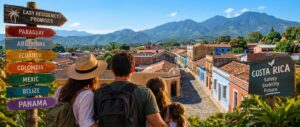
How willing are Romanians to leave Europe behind?
Romanians Abroad Who Are No Longer Going Home
In June 2025, I asked a question in the “Romanians in Costa Rica” group: How willing are Romanians to leave Europe behind? To go even further, to Latin America, Asia, Africa, or Oceania? And we weren’t just referring to Romanians in Europe, but also to those in the United States or Canada, who have spent their whole lives imagining that they’ll return to Romania when they retire.
No matter how many statistics circulate online, we see the reality all around us: in conversations with friends, in online groups, and in the decisions of those who left “for a few months” and ended up staying for decades.
More than a year has passed since then. In the meantime, the question is no longer theoretical. We see it in the people who write to us, in those who have relocated with us, and just as importantly, in those to whom we’ve had to say it’s not possible.
For a long time, the plan for many Romanians who left for Europe or North America was the same: work abroad for a few years, save up some money, then return home. More and more are choosing not to return. They’re looking for something else, and some have even started turning their attention to Costa Rica.
We’re not writing this article to convince you to come. We’re writing it so that anyone considering this step knows from the start what works, what doesn’t, and why.
Why People Leave a Second Time
For those who have already emigrated once, the decision to leave again is harder. You’ve worked for years to integrate, you’ve learned the language, you have friends, maybe even a home. And yet, many end up looking for a new start.
The reasons we hear most often:
- The cost of living (inflation) in Western countries has risen much faster than incomes.
- Uncertainty about the direction things are heading in Europe: economically, socially, and legislatively.
- For many, the hope of returning to Romania has faded. Those who planned to come back “when things calm down” have ended up looking for other destinations.
The advantage these people have is that they already know what emigration entails: bureaucracy, adaptation, and being far from family. They no longer harbor romantic illusions. They compare figures, laws, and conditions.
How the decision varies by age
Ages 18–30: open-minded, but confused
It’s the most mobile and adaptable generation. They move easily, pick up another language quickly, and embrace the idea of a “temporary home.”
However, most still look toward Europe: the Netherlands, Germany, France, Spain, and Ireland. Few dare to look toward Latin America or Asia, although such examples are beginning to emerge.
What’s holding them back: fear of instability, a lack of clear information, and the desire to have a “secure system” to fall back on.
What few people mention: for a young person with no capital and no pension, Costa Rica is one of the most difficult destinations. Without residency, you can’t legally work as an employee, and the realistic residency categories require money that you rarely have at this age. For most young people, the realistic path is to first build a financial foundation and only then consider relocating so far away.
This isn’t just theory. In recent years, I’ve seen at least four or five cases of people who came without a steady income, even though it had been clearly explained to them beforehand what to expect: no right to work, no access to the healthcare system until they complete the DIMEX process, and no bank account. Most of them returned to Europe within a few months. And from here, you can’t hitchhike back home.
Ages 30–45: curiosity combined with pragmatism
This is where the first serious questions arise about quality of life, children’s education, and the real costs of living in Europe. More and more people are considering options like Mexico, Costa Rica, Bali, or Thailand—not for vacation, but for a long-term move.
What motivates them: sky-high prices in the EU, a lack of meaning in office jobs, and European bureaucracy.
What’s holding them back: administrative hurdles, helping their children adjust, and the lack of a concrete plan.
In practice, at this age, the difference between those who dream and those who actually leave is most evident. Those who succeed usually have capital for an investment or a business and a plan for their children’s schooling before they even arrive. Those without a plan usually remain at the stage of mere curiosity.
Ages 45–60: Between “patience” and “enough is enough”
Many left Romania 15, 20, or 30 years ago and now realize that the “European dream” has turned into a struggle for survival. Some are seriously considering moving to warmer, quieter areas. They’re no longer looking for a career, but for security, time, and good health.
What’s holding them back: fear of the unknown, the healthcare systems in countries outside Europe, and the thought that “maybe I can hang on a little longer.”
Most of those who contact us now are in this age group, and this is also where the most obstacles arise, which we’ll discuss below. Our advice for them is simple: don’t leave until you have the money in hand.
Fear of the healthcare system: look at the numbers, not the image of “Europe”
Costa Rica has a life expectancy of 81 years, which is virtually equal to the OECD average, even though it spends about three times less per capita on health care (approximately $1,935, compared to an OECD average of nearly $6,000). Seventy percent of Costa Ricans say they are satisfied with their access to quality healthcare, above the OECD average of 64%.
Costa Rica’s real problem lies in the waiting lists for specialists and scheduled surgeries. In April 2026, approximately 4% of the country’s population was waiting for surgery in the public system and about 7% for a specialist consultation. We make no secret of this.
It’s just that Europe is no longer the benchmark it once was. According to the OECD (Health at a Glance 2025), in France 43% of patients wait between two months and one year to see a specialist, in Sweden 29%, and in Germany 22%. In the United Kingdom, 11% wait over a year. For cataract surgery, most patients in the United Kingdom, Portugal, and Spain wait over three months. In France and Germany, one in five people wait weeks just to see their primary care physician.
The percentages above refer to patients who needed to see a specialist, not the entire population. To make a fair comparison with Costa Rica, we selected countries that publish their waiting lists by number of people:
| Country | Waiting for surgery | Waiting for a specialist |
|---|---|---|
| Costa Rica (April 2026) | ~4% of the population | ~7% of the population |
| Spain (2025) | ~1.77% of the population | ~8.44% of the population |
| England (May 2026) | 11% - 13% | surgery and specialists combined |
France and Germany do not publish comparable national waiting lists, so for those countries we only have the OECD percentages listed above.
The reason has to do with how their systems are organized: their systems are based on multiple insurance providers (public and private), and patients schedule their appointments directly with specialists, without a central waiting list. Spain, the United Kingdom, and Costa Rica, on the other hand, have a unified public system, where wait times are recorded and can be tallied.
This doesn’t mean that people wait less there, just that the wait times don’t show up in the statistics.
There’s one more important thing: the age of the population. In the European Union, 22% of people are over 65. In Costa Rica, it’s about 11.7%, about half. Most of those on waiting lists in Europe are elderly, and the European population is aging every year, so the pressure on healthcare systems there will only increase.
Conclusion: when it comes to surgeries, Costa Rica fares worse than Spain. When it comes to specialists, the situation is roughly the same. England, with its much-praised public system, has proportionally more people on waiting lists than Costa Rica. The difference isn’t that people in Europe don’t wait, but that there you pay much more and still have to wait.
What works very well in Costa Rica: primary care, emergency care, lab tests, and medications—all included in the Caja (CCSS) contribution, which is mandatory for residents and also includes a pension component. For faster access to specialists and lab tests, the practical solution is a combination of public and private care: an inexpensive private subscription (around 7,000 colones per month), which allows you to get lab tests and consultations quickly, then take the results to the Caja for treatment and long-term monitoring. I explained in detail how this works in the article about countries where “residency is easy to obtain.”
An important detail for those aged 45 and older who are also looking at other countries in Latin America: in Uruguay, for example, many mutualistas (private health insurers) no longer accept new enrollees after age 60–65 and may require a medical exam. In Costa Rica, enrollment in the Caja as a resident does not depend on age.
Costa Rica doesn’t have the healthcare system that Europe had 20 years ago.
But then again, neither does Europe today.
60+: Between Children, Retirement, and Peace of Mind
Those whose children have moved abroad tend to follow them. Those who remain in Romania find it harder to leave, but many dream of a warmer, more peaceful place to spend their retirement years. Latin America, Portugal, Greece, or Morocco are becoming popular “retirement” destinations.
For those with a stable pension, Costa Rica offers one of the most reliable paths to residency: the “pensionado” program. The situations of parents without a sufficient pension, who depend on their children, are more delicate, and we discuss them on a case-by-case basis, because every family’s reality is different.
Who Actually Comes to Costa Rica?
The classic image of the “Romanian emigrant” is no longer relevant. Those who have relocated with us over the past year have very different profiles:
- Families from Romania leaving in three generations: parents, children, and dependent grandparents.
- Romanians who have been settled in Western European countries for many years, who have already experienced emigration and know what it means to start over.
- Families from North America nearing retirement, with children and grandchildren, who are looking for a place to settle for the years ahead.
- Families who split their time between countries and aren’t moving all at once, but are gradually building a base here.
The pattern for 2025 is clear: those aged 45 and older seeking security, those aged 60 and older following their children, and families moving together. And they all have something in common: none of them came “on a whim.” They had a plan, a clear source of income, and a residency status that provides them with long-term stability.
Those we stop before they get started
It’s the less pleasant part, but it needs to be said. Many of those who ask us cannot relocate to Costa Rica, and we tell them this straight away, even though we could take their money for a case that has no chance of success.
1. Criminal Record: Costa Rica requires a clean criminal record, legalized or apostilled, from your country of origin or from the country where you have legally resided for the past three years. In the latter case, you must also prove that your stay there was legal by providing a certified copy of your residence permit from that period. For Romanians living abroad, this usually means a criminal record from Italy, Spain, Germany, or the country where they currently live, plus their residence permit. I’ve seen plenty of people who got excited, started making plans, and only then found out that a past issue was blocking their path. The criminal record is checked first, not last. I wrote about this in detail in the article on criminal records.
2. An Unrealistic Budget “I have 5,000–10,000 euros, is that enough to buy something there?” This is one of the most common questions, and, unfortunately, the answer is no. Costa Rica isn’t a cheap country. Prices for food, real estate, and services are often comparable to those in Europe or even higher (see our price comparison). With 5,000–10,000 euros, you’ll barely cover the first few months of rent, paperwork, translations, transportation, and insurance. You won’t be able to buy property or start a business.
3. Capital Tied Up in Real Estate
This is the category that hurts us the most, because these are people who, on paper, have wealth. They own a house, an apartment, or a plot of land, whether it’s in Germany, France, the United Kingdom, Canada, the United States, or Romania. But they don’t have liquid cash. The problem isn’t specific to any one country—it’s widespread.
And right now, they can’t sell. The real estate market is stagnant almost everywhere the diaspora lives: people no longer have the money to buy, and loans—with current interest rates—have become unaffordable for most. It’s all interconnected. Those who own property are stuck where they are—not for lack of will, but for lack of buyers.
For these people, the only honest advice is: don’t leave until you have the money in hand. Don’t count on “I’ll sell it from there once I get there.” If the sale takes two years, you won’t have anything to live on here in the meantime.
Residency Categories
What We Recommend and What We Don't
We're very clear on this, and we know that not everyone does the same.
What We Recommend
Investor (Inversionista) “including through a business”. Many people still find the figure of $150,000 online, but it is no longer valid for new applications. The reduced amount stemmed from Law 9996 of 2021, which was passed after the pandemic to attract investors. The law lowered the threshold from $200,000 to $150,000 and provided benefits such as duty-free import of household goods and up to two cars, or a 20% reduction in the property transfer tax.
Law No. 9996 expired on July 14, 2026, with no extension. For new applications, the old version of the immigration law applies: a minimum of $200,000, without the benefits mentioned above. The situation is still not entirely clear, because even in the old version there are provisions that have been repealed. For this reason, we review each application to determine which provisions apply at the time of submission.
There is another aspect that many overlook. Costa Rica has tightened its anti-money laundering rules, and since 2026, SUGEF centralizes (the banking supervisory authority) “Know Your Customer” (KYC) information, including the source of funds. For an investor, this means they must be able to clearly demonstrate, with documentation, where the money comes from. Money “under the mattress,” from sales without a contract, or from sources that are difficult to prove will create problems, both at the bank and with the residency application.
The money remains yours, in the form of property or a business, and you’re building something for the long term. This is the best path for people aged 30–60 who have available capital.
Our conclusion: budget for $200,000 plus additional costs (documents, notary fees, transfer taxes, translations), and prepare proof of the funds’ origin before transferring them.
Business first, residency later. This is an option we often consider smarter than the $60,000 deposit required for the “Rentista” residency category: you invest the money in an existing business, and after about a year, if the company has started to take off, you can apply for residency as a director or representative of the company. You have a better chance of succeeding because the money is working for you instead of being spent, and in the end, you have both residency and a business that supports you.
Retiree (Pensionado). For those with a stable, lifetime pension of at least $1,000 per month. This is the safest route for those who have reached retirement age or are close to it, because the income doesn’t disappear.
Family-Based (Vínculo), for the principal applicant’s family. When the principal applicant already has residency or qualifies under the Investor or Retiree categories, the family can join them as dependents: the spouse, minor children, and adult children with a documented disability. For some categories, the immigration regulations explicitly mention unmarried children under 25 who are studying and are financially dependent on their parents, while for others they do not. We analyze these differences between categories on a case-by-case basis. It’s not a risk—quite the opposite. Having your family by your side provides enormous support, both physical and emotional, during relocation.
What We Do Not Recommend
Income-Based Residency (Rentista). On paper, it seems like an affordable solution: you prove an income of $2,500 per month, and anyone who doesn’t have that income deposits $60,000 in a Costa Rican bank and obtains residency. The problem is what happens afterward.
That money doesn’t just sit there untouched. You live off it every month. And for many people, especially those in the 45–60 age group, that $60,000 is nearly all their savings. When it’s time to renew, you have to prove you have the same amount or the same income again. If the money has run out and you have no other stable source of income, you’ll be left without money and without legal status in a foreign country, at an age when it’s hard to start over.
We could handle these applications and collect our fee. We don’t do it, because we know where these people end up a few years down the road. If you have $60,000, it’s much better to invest it in something that generates income, as I explained above in “business first, residency later”, han to watch it drain away in a deposit.
Digital nomad. It’s not residency. It’s a temporary stay permit that doesn’t lead to permanent residency, doesn’t give you access to the healthcare system (CCSS), and doesn’t build anything for the future, such as a pension. You pay, stay for a while, and in the end, you’re right back where you started. For anyone who wants to settle down, it makes no sense.
Tourism is not a way of life
Many people imagine they’ll make a living from tourism: a small business or a home rented out through Airbnb. Costa Rica does well in international rankings. Luxury tourism reports list it among the world’s top destinations for families and adventure.
But tourism is here today, gone tomorrow. It depends on the global economy, the American and European markets, airfare prices, and crises that no one can control.
How Much Does Tourism Contribute to Costa Rica's Economy?
According to the Tourism Satellite Account, calculated by the Central Bank in collaboration with the Institute of Tourism (ICT), tourism directly accounts for 6.3% of GDP and nearly 9% of the country’s jobs. When indirect effects—that is, everything related to it—are factored in, it accounts for 8.2% of GDP. Before the pandemic, official figures indicated approximately 10% of GDP and about 600,000 direct and indirect jobs.
On paper, 8–10% doesn’t seem like much. The problem is the ripple effect. A hotel isn’t just rooms and a front desk. Behind it are the farmer selling fruits and vegetables, the bakery, the transporter, the mechanic, the construction company, the laundry, the village store, the bank where everyone has loans, and even the private school where employees send their children. When tourists pay, the money passes through all these hands. When tourists stop coming, everything comes to a halt all at once.
What Happened During the Pandemic
In 2020, it wasn’t just a tourist area that came to a standstill, it was the entire country. Costa Rica received nearly 70% fewer tourists than usual, that is, one-third of the normal number. GDP fell by more than 4%, one of the sharpest declines on record. Around 255,000 jobs were lost in 2020 alone, nearly 84,000 new households fell into poverty, and approximately 5% of the country’s businesses went out of business.
These are the official figures. What doesn’t appear in any statistics is just how far the ripple effect spread. No government will admit that a sector accounting for 6–8% of GDP dragged down a significant portion of the economy, but that’s what we’ve seen on the ground.
Many of those working in tourism had come from other regions of the country because that’s where the jobs were. When tourism came to a halt, they were left with no income: no money for rent, food, bills—nothing. They returned home to their families. Except that, in most cases, their families were in the same situation. They worked in agriculture or in processing plants, which had also been “put on hold.” The only difference was that they had a roof over their heads.
That’s when bartering made a comeback. People gave what they could afford to give and received in exchange what they lacked: vegetables for eggs, a helping hand for a bag of rice. It wasn’t nostalgia for the old days, but the only economy that still worked.
Meanwhile, the domino effect had begun. People no longer had money, so they bought only the bare necessities. Many supermarkets and small stores went out of business, while others were left with merchandise on their shelves until it spoiled or expired. People started buying their clothes from “ropa americana”—secondhand clothing stores—because they were cheaper, and putting food on the table came first. This, in turn, hit clothing stores and garment factories hard.
Transportation companies were among the first to close, as many relied on tourism for over 90% of their revenue. Along with them went the local mechanics, tire shops, and gas stations. Farmers weren’t spared either: hotels and restaurants stopped buying their produce, and locals didn’t even have money for a garden plant.
And unlike in Europe, Costa Rica does not have unemployment benefits. Pandemic relief was temporary and limited. The situation was so dire that legal measures were enacted allowing companies that closed to be exempt from paying severance to employees. Those who lost their jobs were left, in many cases, with only what they had saved.
One thing is worth noting, however: even during the toughest period, no one in Costa Rica was confined to their home, and no one needed a permit to go out on the street. There were restrictions, but freedom of movement remained.
If we were to recount everything that happened back then, it would fill a book, not just a chapter. The point is simple: the ripple effect of a sector that accounted for “only 8%” spread throughout the entire country.
When it works, it works for everyone
The same effect works in reverse as well. In 2024, tourism revenue reached an all-time high of over $5.4 billion, and that money trickled down throughout the economy. Tourism isn’t a bad thing—quite the contrary. It’s just that a relocation can’t rely solely on it.
In a nutshell
What you need to know before you seriously consider Costa Rica:
- A clean criminal record, verified before taking any further steps.
- A stable and verifiable long-term source of income: investment or pension.
- Capital available in hand, not tied up in a property you hope to sell.
- A realistic budget for the first year, separate from the cost of residency.
- Realistic expectations: Costa Rica isn’t a cheap country, nor is it a problem-free paradise. It’s a stable country with clear rules, where you can build a long-term future if you come prepared.
The question from 2025 remains relevant: How willing are Romanians to leave Europe behind? The answer we’re seeing now is that many are willing, but few are prepared. If you are among those who are prepared and would like to discuss your specific situation, please contact us. If you are not yet prepared, it is better to wait a little longer than to leave unprepared. We say this from experience.

Sources
Healthcare System
- OECD, Health at a Glance 2025, Costa Rica
- Euronews, Waiting Times in Europe (based on OECD Health at a Glance 2025)
- La Nación, CCSS waiting lists, April 2026
- Euronews España, Surgical Waiting Lists, Spain 2025
- Última Hora, Patients Waiting to See a Specialist per 1,000 Residents, Spain
- Healthcare & Protection, NHS England waiting list, May 2026
- Eurostat, age structure of the EU population, 2025
- Delfino, population aged 65 and over in Costa Rica, 2025
- CRHoy, INEC projections for 2050
 Behind OpenZone are two people: a Costa Rican native with deep roots in the local history, and an expat who has been settled here for over two decades. Together, we combine native knowledge of the system with firsthand experience of the very process you’re going through right now.